
How Big a Mortuary Cooler Do You Need?
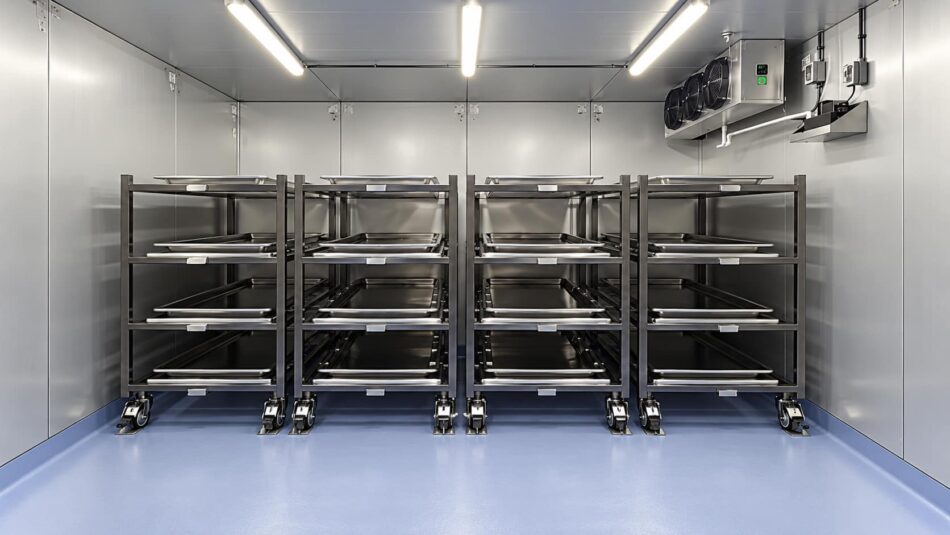
The most common mistake in buying a mortuary cooler is sizing it for an average week. Average weeks are easy. The weeks that test your facility are the ones when four calls arrive in two days, a family needs extra time, or the crematory schedule backs up. This guide shows you how to size for those weeks, with worked examples you can adapt to your own numbers.
Step 1: Count your cases
Start with the number of calls or cases you handle in a year. Funeral homes can pull this from their case management records. Hospitals and medical examiners can use decedent intake logs.
Divide by 365 to get your average daily intake.
- 100 cases a year ÷ 365 = about 0.3 a day
- 300 cases a year ÷ 365 = about 0.8 a day
- 600 cases a year ÷ 365 = about 1.6 a day
Step 2: Estimate your average holding time
Holding time is how many days a body stays in your cooler before services, transfer, autopsy or cremation. It varies with:
- Your mix of burial and cremation, since cremation often involves permits, authorizations and scheduling
- How quickly families make arrangements
- Weekends and holidays, when paperwork and transfers slow down
- Autopsy or investigation, for hospitals and medical examiners
If you don’t track it, look at a sample of recent cases and count the days from intake to release. The examples below use 3 days.
Step 3: Work out bodies on hand
Multiply average daily intake by average holding days. That’s how many bodies you hold on a typical day.
- 3 a day × 3 days = about 1 body on hand
- 8 a day × 3 days = about 2 to 3 bodies on hand
- 6 a day × 3 days = about 5 bodies on hand
Step 4: Plan for peaks
Your busiest weeks can easily be twice your average, and winter, holidays and local events can push that higher. Multiply bodies on hand by a peak factor. The examples below use 2. If you’ve been caught short before, use a higher number.
| Cases per year | Bodies on hand (average) | Bodies on hand (peak) | Typical fit |
|---|---|---|---|
| 100 | About 1 | About 2 | 2-body box |
| 300 | About 2 to 3 | About 5 | 4-body box plus overflow, or a 6-space walk-in |
| 600 | About 5 | About 10 | Walk-in with 10 to 12 rack positions |
Step 5: Add room to grow
A mortuary cooler is a long-term purchase. AWIC panels carry a 20-year warranty, so size for the facility you’ll be running years from now. Ask yourself:
- Is your case volume growing?
- Are you adding cremation, or taking overflow from another location?
- Would you rather add capacity now than buy a second unit in five years?
If the answer to any of these is yes, round up. Walk-in coolers built from cam-lock panels can be expanded later, but planning the space now is cheaper than moving walls later.
Step 6: Check the space
Now match capacity to the room you have:
- Body boxes fit 2 to 4 bodies in a compact footprint. Check the outside dimensions and the delivery path, including doors, hallways and turns.
- Walk-ins need a room or an outdoor pad, but they hold more bodies per square foot as you add rack tiers. A 3-tier rack holds three bodies in the footprint of one, and taller racks hold more.
- Door clearance. Measure your widest cot or rack. The cooler door needs to be wider.
- Clearance above. Leave about 36″ above a top-mounted refrigeration unit for service and airflow.
Worked example: a 300-call funeral home
A funeral home handles 300 calls a year, about 60% of them cremations. Cremation cases often hold longer, so the director estimates an average of 3½ days.
- 300 ÷ 365 = 0.82 a day
- 82 × 3.5 days = 2.9 bodies on hand on an average day
- 9 × 2 (peak) = about 6 bodies in a busy week
A single 4-body box would leave them short in peak weeks. Better options include a 4-body box plus a 2-body box for overflow, or a small walk-in with 6 to 8 rack positions and room to add more.
Quick answers
How many bodies fit in a walk-in mortuary cooler?
It depends on two things: the cooler’s floor space and the rack height. Each rack tier holds one body, so a 3-tier rolling rack holds three bodies in the floor space of one. AWIC builds end-loading rolling racks from 3 to 5 tiers, and a taller cooler leaves room for taller racks. Multiply the number of racks that fit on the floor by the tiers per rack to get the cooler’s capacity.
Don’t fill every square foot with racks. Staff needs an aisle wide enough to bring a cot in, line it up with a rack, and turn around, and the door has to be wide enough for your widest cot or rack. Our compact 3-tier rolling-rack cooler measures 57½” x 8′ x 8′ high, and we build larger walk-ins to whatever length your room allows. Send us your room dimensions and how many positions you need, and we’ll lay out the racks and aisle to fit.
Should I buy one large cooler or two small ones?
Two smaller units give you a backup: if one needs service, the other keeps working. You can also place them in different spots, and you can buy the second one later as your case volume grows. The trade-off is maintaining two refrigeration systems, finding room for two footprints, and having less space for your team to work inside either unit.
One walk-in shares a single door, refrigeration system, and set of controls across every position, so the cost per space can drop as you add capacity. Your staff can walk in, check identification, and move bodies on rolling racks without unloading a shelf, and cam-lock panels let you lengthen the room later. You can also have both: a walk-in for daily use and a body box for overflow and backup. Get quotes for both setups and compare the cost per space. Walk-In vs. Body Box Mortuary Coolers goes through the trade-offs in more detail.
Get help sizing your cooler
Send us your annual case volume, a rough holding time, and your room dimensions. We’ll recommend a size and send a quote. Call 1-800-430-4468 or request a quote.